
Review of "This is Not a Cookbook"
by Juliana Shaum
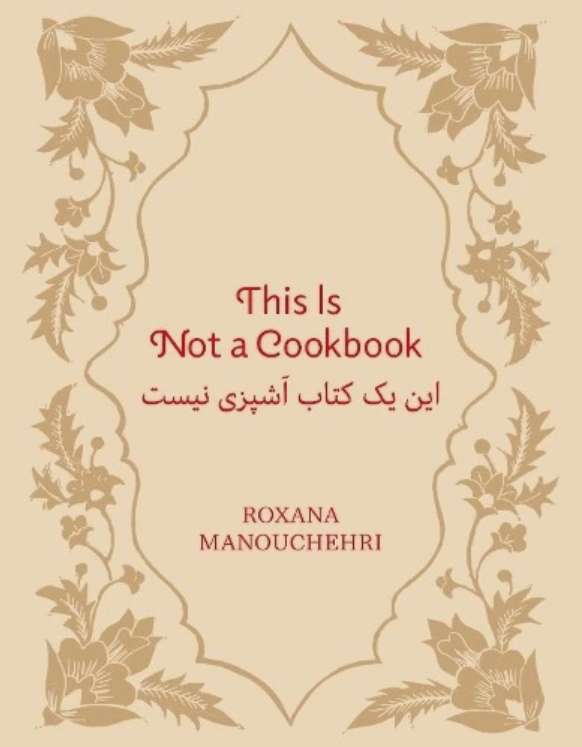
Roxana Manouchehri, This Is Not a Cookbook (Skein Press, 2025).
What role can literature play amid the ever-deepening state of permacrisis that we live in both as individuals and collectives? One of many possible answers to this question becomes material with Roxana Manouchehri’s This Is Not a Cookbook. The Iranian-Irish artist responds to her displacement from her upbringing in Tehran in the aftermath of the Iranian Revolution to her search for belonging in her present life in Dublin by weaving together memories and Iranian recipes handed down to her from her family. Published by Skein Press in 2025, the book also exemplifies the Dublin-based independent publisher’s commitment to amplifying voices that have historically been underrepresented within Irish publishing.
A web of relationships & memories
In each of her ten entries, decorated richly with lithography, patterns and motifs from Iran and beyond, Manouchehri connects a personal story with her own version of a Persian dish, handed down via generations of women and daughters. In this way, the food always has a context of family, culture and memory. I would argue that Manouchehri's insistence that every recipe has a story, every ingredient has a history, and every meal carries political meaning can be read as a form of political resistance. Food, from this perspective, has the ability to tie the past to the present in a way that is not abstract, but very tangible. In a way, food becomes a signifier of that which remains through decades of life and struggle, a site of where collective memory survives. Yet, This Is Not a Cookbook also hints at that which is lost. For instance, we as readers get to experience how Tahdig, a smoked Persian rice, is interwoven in an essential way with the author’s memory of the day in which her family learned that her cousin, just 21 at the time, had been killed in the war. Understood in this context, food also preserves traces of lives, relationships and places that can no longer be recovered, and has the ability to also make absence tangible.
Iranian diaspora situated in Dublin
Having lived in Dublin for fifteen years, Manouchehri situates her reflections firmly within the city. She notes how she likes to honor Norooz, the Persian New Year’s Eve, in her Dublin flat or that she likes to buy Persian rice in the Afghan supermarket on Capel Street. The ability, or inability, to find particular Persian foods in Dublin reveals how diasporic communities remake cities while remaining connected to places elsewhere. Additionally, knowing where to find ingredients in Dublin and grounds the book in actual Persian social life in Ireland rather than in an abstract notion of multiculturalism.
An invitation to active participation
This Is Not a Cookbook is not a cookbook, but a memoir reflecting on the Iranian diaspora in Ireland which invites its readers to become part of this relationship by interacting with this book. Against capitalist socioeconomic structures which increasingly reduce food to lifestyle branding, nutritional optimisation, or consumer choice, Manouchehri’s book insists on food’s social and historical dimensions. At a moment when both food and culture are increasingly commodified, Manouchehri's recipes insist on another understanding of nourishment: one rooted in memory, care, reciprocity and collective survival. In that sense, the book is not merely about food. It is about the social worlds that food makes possible. If literature has a role in the permacrisis, This Is Not a Cookbook suggests that it lies not only in offering grand solutions but in preserving and creating forms of connection. By inviting readers to cook, eat and remember, Manouchehri transforms reading from passive consumption into active participation with her diasporic experience, and food as a bridge between cultures rather than a commodity to be extracted.
As Manouchehri writes:
“It is my hope that the beautiful tastes, sights and smells of the food that we share might, in some small way, bring us together and ease our passage through these hard times.”
This sentiment captures the book’s central achievement. Through food, memory and storytelling, This Is Not a Cookbook offers not an escape from the permacrisis, but a way of being with it in community.