
Rupture in the backseat? A review of "Radical Abundance"
By Paul Murphy
Kai Heron, Keir Milburn and Bertie Russell, Radical Abundance: How to Win A Green Democratic Future (Pluto Press, 2025)
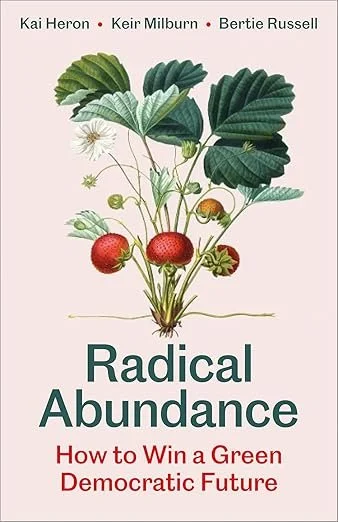
Radical Abundance is part searing critique of the bullshit abundance produced by capital, part strategic argument about how we can get beyond capital, and part outline for putting these ideas into practice. On all three fronts, it is a serious, considered and thought-provoking intervention.
The abundance to which authors Kai Heron, Keir Milburn and Bertie Russell aspire has nothing to do with the so-called ‘abundance agenda’ of Ezra Klein. This is simply repackaged deregulation and market liberalisation. Instead, radical abundance is “at the heart of the communist tradition”, a society which has transcended the struggle for scarce resources. This can and must take place within the biophysical limits of our planet.
This is contrasted with the ‘bullshit abundance’ which capitalism serves us. An abundance of microplastics, greenhouse gas emissions, low-quality mass-produced consumer goods, and traffic. The other end of this capitalist pole is artificial scarcity. Artificial scarcity of high-quality food, of musical complexity (as music rapidly homogenises due to the drive for profit), of biodiversity.
The authors present a compelling case of the necessity of ecosocialist change:
“[R]adical abundance is the antithesis of bullshit abundance. It’s the product of society organised not to realise profits for the capitalist, rentier, and asset holding classes, but to maximise the capacity for human and non-human life to flourish…. through processes of democratic social and ecological planning, and through the common ownership of the things we need to forge enriching lives, workers and their communities can ensure that everyone has everything they need to live, love, care, and maximise their time on this earth.”
The question is: how to get there?
The authors propose Public-Common Partnerships (PCPs) - as a “cell-form of socialist construction today” that can be “a network of institutions that can empower workers to democratically deliberate about how to use the social surplus generated by their collective labour.” This is effectively the opposite of Public-Private Partnerships, which have seen public resources funnelled toward private profit. Instead, PCPs are a model of ownership which has both worker and broader community control.
Later chapters of the book get into detail about how PCPs can work in practice. For example, in their work around a mixed-use market at Wards Corner in Tottenham, North London. In opposition to a plan for gentrification and corporate urban development, the authors worked with local campaigners, including traders and residents, to develop an alternative. Governance for the site would be passed to a board which would include representatives of residents, market-traders, ethical investors, and the development trust and Transport for London, which had the freehold of the site. Where this PCP model differs from traditional worker co-operatives is the conscious involvement of the community - with wealth generated beyond workers’ wages coming under the control of a wider democratic body.
Although parts of the book are somewhat technical in spelling out how PCPs can operate in different economic and community contexts, this is not simply a ‘utopian’ project of dreaming up a better way of how parts of our economy could be governed. Instead, agree or disagree (and I will raise some disagreements), it should be recognised as a serious strategic proposal rooted in an understanding of the pervasive nature of capital and the necessity for a theory of transition.
““Where this PCP model differs from traditional worker co-operatives is the conscious involvement of the community - with wealth generated beyond workers’ wages coming under the control of a wider democratic body.””
Beyond Capital
The strategic framework the authors utilise is that of Hungarian Marxist, István Mészáros, who emphasised the power of capital beyond capitalism as a system. As the authors paraphrase Mészáros:
“As a mode of metabolic control, capital is a kind of power that inflects itself through and inflects our day-to-day interactions with one another and with non-human nature. It mediates our everyday dealings, our metabolic exchanges, and thus our collective reproduction.”
In other words, simply overthrowing capitalism - the organisation of society on the basis of private production for profit - is insufficient. As Mészáros argues:
“you can overthrow the capitalist but the factory system remains, the division of labour remains, nothing has changed in the metabolic functions of society. Indeed, sooner or later you find the need for assigning those forms of control to personalities, and that’s how the bureaucracy comes into existence.”
Theorising the transition, therefore, from capitalism and capital as a system of metabolic control to communism is paramount. The authors explicitly reject what they see as two dominant tendencies in leftist thought about transition - the reformist trend, which considers the problems of transition resolved by taking governmental power, and secondly, the ‘change the world without taking power’ tendency of horizontalism.
They posit, instead, a focus on what they consider to be the invariant features of anti-capitalist transition: “popular protagonism” and “contested reproduction”.
Popular protagonism, a term coined by Marta Harnecker, refers to the development of a “collective consciousness” whereby the working class or ‘popular’ class are “transformed” through democratic process and learning to collectively plan their societies. Through this activity, the working class becomes the revolutionary agent of change. The workers’ councils (Soviets) developed by workers in Russia in 1905, and which ultimately came to political power in October 1917, are the best-known example.
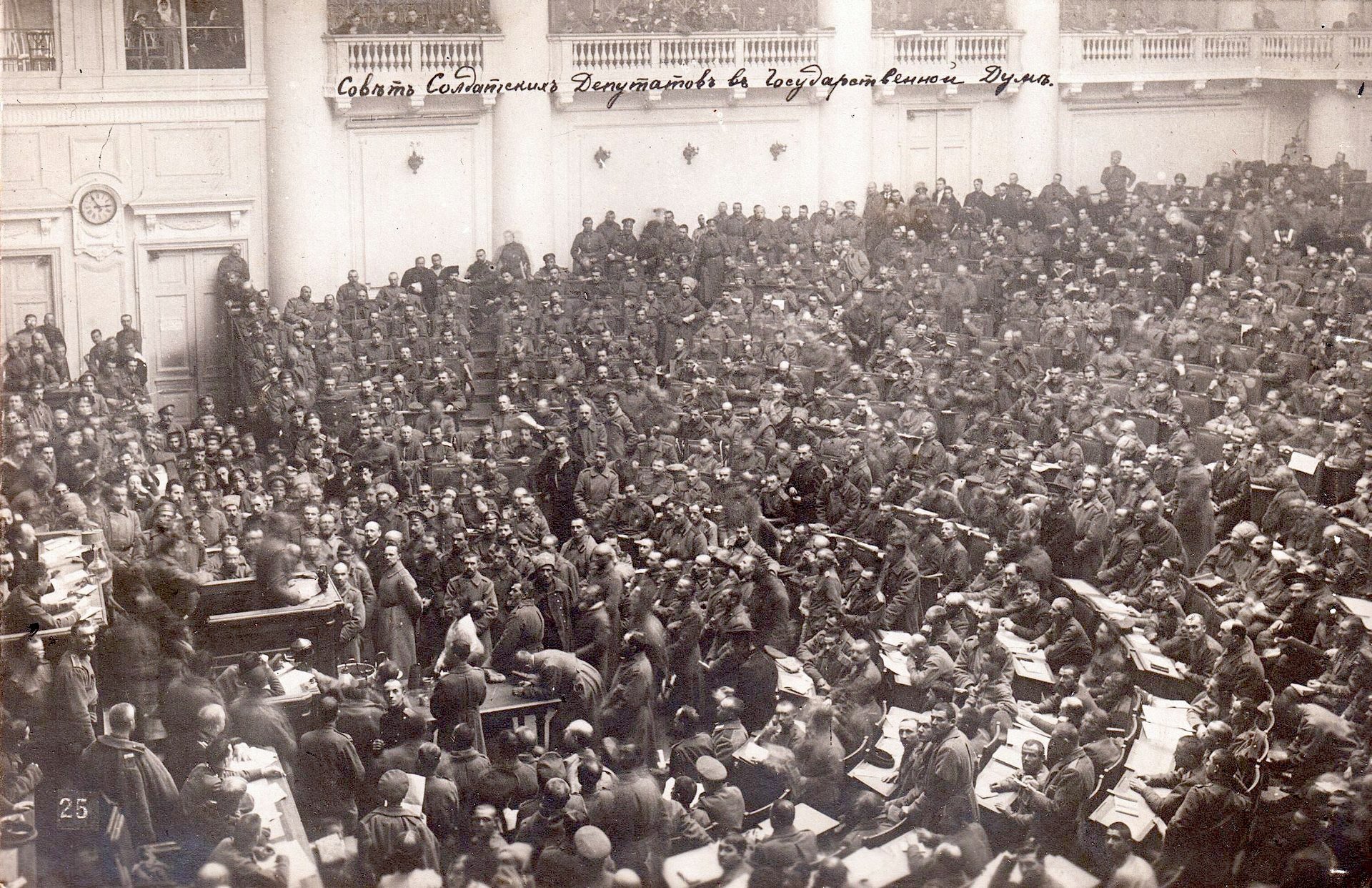
Petrograd Soviet, 1917
Working class people are incredibly atomised in capitalist society, with all kinds of competing interests and conflicting ideas. As the authors point out, “to overcome collective atomism and build popular protagonism requires institutional forms that foster a universal class consciousness and the institutional means to facilitate strategic coordination and economic planning at scale.”
Uniting the working class such that it becomes a class “for itself” is surely one of the most pressing challenges of our time. And, considering the importance of the transition “beyond capital”, we’re not just talking about what’s necessary to overthrow capitalism, but that which is prepared to usher in a radically different social metabolic order. Heron, Milburn, and Russell suggest PCPs could be the basis for the construction of communes.
“Contested reproduction” relates to Mészáros’ understanding of capital’s metabolic control. It refers to establishing spaces where the organisation of the economy for profit (capital’s law of value) can be undermined by the development and reinforcing of social relations which emphasise production for people’s needs. A good practical example of what this could look like within a PCP, given by the authors, would be a decision by a Common Association not to accept any gambling advertisement by a footballing club Joint Enterprise, rejecting the economic logic which would normally dictate it.
Real world examples
The examples they give are inspiring. Along with the market in North London, they examine in some detail an initiative in the pharmaceutical sector in France and food production systems in England. In opposition to the dominance of pharmaceutical production by major multinationals and the bullshit abundance of newly marketed drugs - which fail to offer any extra benefit, combined with the artificial scarcity of necessary drugs - a group of French health and commons activists began exploring the possibility of organising pharmaceutical production as a commons in 2021. The authors make the case for the development of a PCP in generic medicine manufacturing based on a particular site at Saint-Genis-Laval.
The other example they detail is a proposal to use England’s council farm estate as a step towards agroecological food sovereignty. This is inspired by the actions of Brazil’s Landless Workers’ Movement (MST), which is famous for organising land occupations and then mobilising to demand expropriation. The authors argue that council farms (the acreage of which has fallen by more than half since the late 1970s) could form the basis of a PCP, together with the creation of a democratic “Food Sovereignty Council”, responsible for governing the social, ecological and food production objectives of participating farms. This would sit alongside a democratic “Common Food Association” which would be responsible for expanding common food production and provisioning.
The more PCP and PCP-like projects, the better. Loosening the grip of capital’s control will give people better lives today as well as expand the capacity of working people to be able to govern in a post-capitalist society. It will raise people’s sights beyond the dominant ‘capitalist realism’, which sees the organisation of society around profit as inevitable. Socialists should enthusiastically support initiatives in this direction and get involved. The closest thing we have so far in Ireland is the development of the Bohemian’s Building Community Wealth Strategy.
However, to treat the authors’ argument with the seriousness it deserves, it should be recognised that they are arguing for more than mere support for such projects. Instead, they are arguing for an “organisational turn” by socialists to prioritise the work of building Public-Common Partnerships. To balance this, they also write that “we are not suggesting that everyone stop the organising they may already be doing and build PCPs. PCPs don’t need to be, and shouldn’t be, the only strategy that people turn to.” Nonetheless, they are making the case that PCPs are a “worthy conjunctural wager”.
““Loosening the grip of capital’s control will give people better lives today as well as expand the capacity of working people to be able to govern in a post-capitalist society.””
Which strategic wager?
I think the authors are right to emphasise the power of capital to shape social relations and the need for a theory of transition to break capital’s control. We should not imagine that a revolutionary rupture (like that of October 1917) ends capital’s control. Instead, as the authors argue, “revolutionary transition is a protracted process of replacing capital’s metabolic control with democratically planned production determined by the associated producers.”
However, it is worth interrogating the role of rupture within this process. While opposing a reformist theory of change, the authors downplay the significance of a revolutionary moment where power passes from one class to another:
“The idea of a decisive rupture makes for an exciting narrative arc, but it does not reflect the history of past and present projects in socialist construction. Overemphasising the symbolic and heroic moment in which power appears to transfer from one class to another — or where one metabolic order begins to dominate over another — underplays the messy, patient, and protracted realities of transition. To properly theorise what it takes to establish a ‘self-sustaining alternative social metabolic order’ to capital, the idea of revolution as rupture must take a backseat to the notion of transition as an enduring period of struggle for supremacy between two metabolic systems: capital and a communal system.”
Perhaps, unsurprisingly, in a magazine named Rupture, I would make a different case. A revolutionary rupture from capitalism, establishing a workers’ state where the popular masses are in control, consciously organising the transition. This should be in the front seat of our revolutionary strategy.
The reason for this is the role of the state, about which the book appears partially ambiguous. It usefully points to examples of ‘hacking’ existing legislation for the benefit of working class struggles. For example, the use of Article 15 of the German Constitution to call a referendum on the expropriation of the properties of institutional landlords in Berlin, the use of a legal Community Benefit society as a model of ownership as part of a PCP in Wards Corner, or the use of Council farms as a launching point for agricultural PCPs. However, there is a difference between using mechanisms opened up by the capitalist state to pursue our own aims and underestimating the power of that state to block any serious challenge to capital.
The authors pose the question: “Why should public money go to derisking private ownership and gain, we should ask, when it could go to derisking publicly or commonly owned assets and production?” Rhetorically, this question may be useful in raising expectations and helping to expose the role of the state within our communities and workplaces. But we should ourselves understand the answer is simple - because public money is controlled by the capitalist state, which serves the private owners who benefit from derisking. That is not to counsel giving up - but to recognise that any such projects will face implacable opposition and limited space to operate.
This opposition appears to be underestimated by the authors who argue:
“Just as there’s no reason why a state can’t support the founding of PCPs today, there’s no reason why workers and communities can’t organise to establish them. PCPs are not conditional on some prior phase of organising — there’s no need to elect a sympathetic local councillor or national government — nor are they a strategy that is entirely about what we might achieve in our spare time.”
But doesn’t this understate the difficulty of finding and maintaining the space, both physical and political, for such a development? Evidence of this is surely provided by the relative absence of positive PCP examples to point to. Successful examples will involve a relatively tiny minority of the population.
Even the more general examples highlighted in the book underscore the point. In a section titled ‘Instituting Popular Protagonism’, they list five: Hernani in the Basque Country, the Deutsche Wohnen campaign in Berlin, the People’s Assembly in Jackson, Mississippi, the People’s Planning Campaign in Kerala, India, and the Popular Power Laws in Venezuela. All are inspirational examples of struggle which have much to teach us. But three of them have been recently confronted with the problems of the capitalist state and imperialism.
In Berlin, the authorities simply refused to implement the will of the people expressed in the referendum. As the authors point out, the campaign has responded by moving for a second binding referendum. In Kerala, the Left Front lost the election and governmental power in February, with the new right-wing government set to dismantle many of the gains. In Venezuela, we saw an armed incursion by the US military, killing around 100 Venezuelans and Cubans and kidnapping President Nicolás Maduro and Cilia Flores. The new President, Delcy Rodriguez, appears to be collaborating with Trump in rolling back the achievements of the revolutionary process in Venezuela.
The transition
The consequence of a powerful and hostile capitalist state is that the bulk of the work of transition lies beyond the point of rupture, not before it - which appears to be in contradiction to what the authors believe. They refer to the work of Soviet political economist Evgenii Preobrazhensky, who wrote about the need for “the ousting of other economic forms, the subordination of these forms to the new form, and their gradual elimination.” But as they note, “the period of contested reproduction with which he was concerned came after a revolutionary party had taken control of the state.”
““the consequence of a powerful and hostile capitalist state is that the bulk of the work of transition lies beyond the point of rupture, not before it - which appears to be in contradiction to what the authors believe.””
This, perhaps, contains the key to understanding the difference in approach. I would argue that a revolutionary party had not “taken control of the state”. Instead, the Bolsheviks led a working class uprising, which dismantled the capitalist state and replaced it with a democratic workers’ state, based on institutions of popular protagonism, namely the Soviets.
It points to a different strategic conception - one that fits neither of the strategies (electoral focus or horizontalism) that they counterpose their approach to. That is a ruptural strategy of seeking to overturn the capitalist state through a revolution from below. An integral part of this process will be the building of an alternative power structure, which then contests with the old capitalist state for power. In other words, a period of “dual power”.
The moment of rupture is when power passes decisively from the capitalist state to democratic institutions of workers’ power. It is primarily after that point of rupture that the economic transition can be progressed. Indeed, the revolution itself isn’t just a moment, but a vital process by which the popular masses utilise new democratic institutions to battle against the old state. This process transforms the oppressed classes and opens the door to radically reorganising the social metabolic order.
Lenin argued: “One of the fundamental differences between bourgeois revolution and socialist revolution is that for the bourgeois revolution, which arises out of feudalism, the new economic organisations are gradually created in the womb of the old order, gradually changing all the aspects of feudal society. The bourgeois revolution faced only one task—to sweep away, to cast aside, to destroy all the fetters of the preceding social order. By fulfilling this task every bourgeois revolution fulfils all that is required of it; it accelerates the growth of capitalism.”
The socialist revolution is very different because a socialist economy cannot substantially grow within a capitalist society. The working class is, by definition, a class without ownership of the means of production. The capitalist state will seek to prevent any large-scale emergence of a socialist alternative.
None of this is to downplay the real problems of transition that are posed by Mészaros, nor the importance of popular protagonism as advocated by Heron, Millburn and Russell. But it is to argue that the space for large-scale “contested reproduction” in advance of a revolutionary rupture is limited. Therefore, in my view, the wiser strategic wager is to build towards a mass democratic rupture.
What that means in this moment of retreat in class consciousness and organisation is conscious day-to-day engagement in class and anti-oppression struggles. To assist in winning victories and the development of socialist consciousness and working class institutions (trade unions, parties, community organisations etc.). Within and through that work, we should always be seeking to build the forces of revolutionary Marxism, convincing the vanguard sections of oppressed people to help build a revolutionary party with deep roots in communities and the foresight for the bigger battles to come.