
Tuning Into Nature
By Natasha Ariff
We respond to our first sounds around 20 weeks in the womb. The early prominent sounds we hear are of our mother’s heartbeat, her in and out breadth, even the gurgling of her stomach. From that point onwards, our ears are permanently turned on. This ability to hear, even when sleeping, enables us to sense and process the sounds in our environment. The magic of hearing happens when our outer ears funnel the vibrations in the air (or water) into our middle and inner ears, generating nerve impulses that are sent to the auditory cortex or ‘hearing centre’ of our brain. Having two ears enables us to figure out how far and in which direction a sound is coming from, a process known as binaural hearing. This ability can alert us to possible dangers or help orient us. People who are blind can use human echolocation to orient themselves. They interpret the sound waves reflected by nearby objects, accurately identifying their location and size by tapping their canes, lightly stomping their foot, snapping their fingers, or making clicking noises with their mouths.
The diversity of sounds we can hear typically ranges from 20 to 20,000 hertz. Hertz are a measure of frequency, and humans perceive these sound frequencies as pitch. The lower the hertz, the lower the frequency or pitch. Infrasound are frequencies below 20 hertz, while frequencies higher than the upper audible limit of human hearing are called ultrasound. Animals such as bats, dolphins and whales use high-pitch ultrasound and echolocation to navigate and locate prey, whilst initial studies have indicated that rhinoceroses and elephants use their low rumbling infrasound to communicate over long distances. Elephants can hear at frequencies 20 times lower than humans, even using receptors in their trunks and feet to pick up low-frequency vibrations. Even our beautiful Earth has its own vibrational hum [1], though the frequency is thousands of times lower than the hearing threshold of the human ear. Special seismometers located at the bottom of the ocean are needed to capture the hum.
To prevent sensory overload, humans have another ability - to selectively hear certain sounds and block out others. For example, the din of voices in a restaurant might be suppressed in our consciousness, while the voice of the person we’re talking to is filtered and amplified, a phenomenon known as dichotic listening. This permanent and automatic assessment is essential, since we’re unable to focus on all the sounds around us. Sounds, particularly in the form of music, could also be involved in forming memories and can play an important role in the study of Post-Traumatic Stress Disorder (PTSD) - as loud sounds can trigger negative responses in people suffering from PTSD.
Despite all the wonders of our hearing perception, we live in a highly visual world. In a hierarchy of senses, we rate our hearing as second. In a study undertaken by Francis B. Colavita [2], it was found that when both visual and auditory stimuli were simultaneously present, participants showed a strong tendency to respond to the visual stimulus, with some participants frequently reporting not having perceived the auditory stimulus at all, i.e. they heard nothing! However, Fabian Hutmacher states that the extent of the “Colavita (visual dominance) effect” is debatable and that the ‘dominance of the visual is socially and culturally reinforced and not simply a law of nature’ [3]. Julian Treasure goes one step further, stating that through the advent of reading and writing ‘our relationship with the world has dramatically tilted and become heavily weighted to the eyes’ [4]. Furthermore, “Screens on mobile devices have further increased the dominance of the eyes as most people’s primary portal to reality.” [5]
Anthropony, Geophony, and Biophony
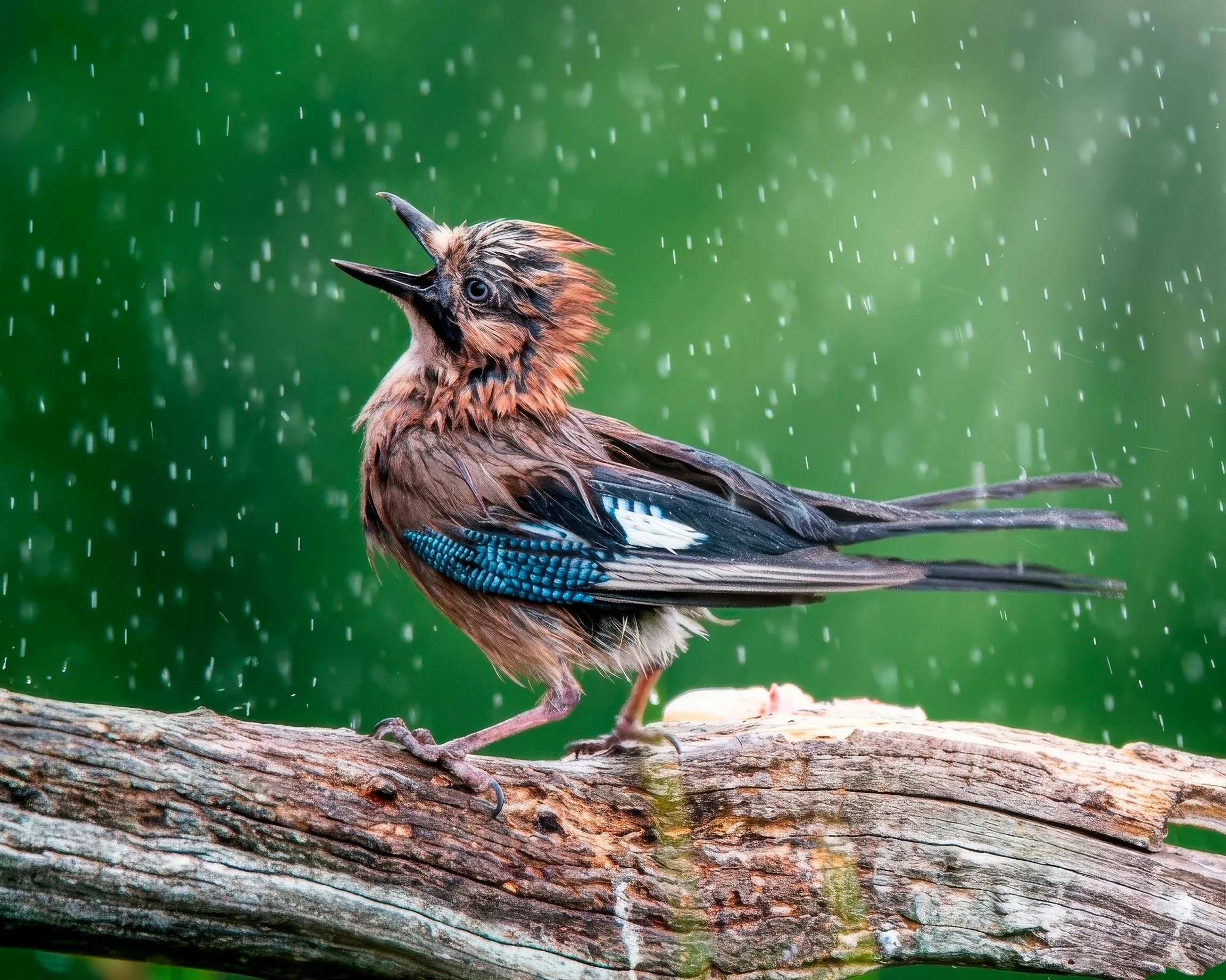
However, hearing has one distinct advantage compared to sight: sound waves propagate around objects while light gets reflected by them, allowing us to hear sounds that are not in our line of sight. In a world of movement, sound is everywhere. Objects hitting or rubbing against each other, air vibrated by vocal cords, the rattling, squealing, honking noise of traffic, the roar of the jet engine overhead. These human-generated noises are described as anthrophony and are the common soundscapes of our urban landscape. But what do we hear when we go for a walk in the park, along a river or in a native woodland? We hear lots of sound, but are we actually listening? Hearing is a passive act, but listening is an active skill. If we pay attention, do we hear the sound of rustling leaves, the pitter patter of gentle rain or the gurgling of streams - these natural sounds or geophony originate from the geophysical environment, that is, sounds made from wind, water, thunder or the movement of earth. Or perhaps we hear the buzz of the bumblebee or the flapping wings of a bird or the wonderful dawn chorus in spring? These are described as biophony, or the collection of sounds produced by all living organisms.
The collection of these different types of sounds - anthrophony, geophony and biophony - make up the soundscape of an area or landscape. The study of these acoustic relationships, that is between living organisms, be they human and/ or other species, and their environment, is an emerging new science, now referred to as soundscape ecology [6]. Ecologists have, for some time now, been intrigued by these soundscapes and what they can tell us. Bernie Kraus, the father of soundscape ecology, calls these soundscapes the ‘narrative of place’ or the ‘voice of a living habitat’ [7]. He proposed the Acoustic Niche Hypothesis [8], which explains how animals in a given habitat all find frequency niches and bandwidths in which to vocalise so that they stay out of each other’s way. As their survival often depends on their voices, they have to find clear channels to vocalise and not be drowned out by other animals/sounds in the ecosystem.
Disrupted soundscapes
““By listening to our environment and recording the soundscape changes over time, we can learn so much about biodiversity, about whether or not an ecosystem is healthy and the species that live in it.””
By studying soundscapes and using visualisations of soundwaves at various frequencies, otherwise known as spectrograms, we see these different niches being occupied by different species. A spectrogram is a visual way of representing the signal strength, or “loudness”, of a signal over time at various frequencies. Using spectrograms, we can see that as anthrophony, or human-generated noise, increases, biophony, or the biological sound in the environment, decreases. Research work from soundscape ecologists, such as Bryan Pijanowski, shows that in a really diverse ecosystem, the spectrogram holds many different frequencies [9]. These spectrograms act as signatures for these ecosystems. Soundscapes that contain a large degree of acoustic frequency diversity are referred to as ‘‘hi-fi’’; these sounds can be heard clearly and are not masked or crowded. These are healthy, intact ecosystems such as virgin rainforests. In ‘‘lo-fi’’ soundscapes, one frequency spectrum (often low frequencies, such as in urban environments) dominates and distant sounds cannot be discerned. Even chopping a few trees in a forest can have an effect on the soundscape and cause the forest to sound really different.
Of course, even in diverse ecosystems, the soundscapes change over time. The ecologists, therefore, are capturing a snapshot or a single moment in time with these audio recorders. What happens to the soundscape of a desert when it rains? Or the diurnal changes from dawn to dusk in the countryside? In terms of temperature, sound waves move faster in warm air and slower in cold air. So, as sound moves through the atmosphere, some parts of the sound wave will be moving faster than the rest. In the evening, when the sun has set, the air is cooler at the surface, and the sound waves are refracted back towards the ground. The opposite happens during the daytime on a hot, sunny day - sound is refracted up into the atmosphere and away from our ears. Have you ever noticed how traffic noise from farther away suddenly becomes louder in the late summer evenings? Animals too may be responding to temperature or the effects of ambient sound. Why do birds sing in the early morning to produce the dawn chorus in the late spring-early summer?
By listening to our environment and recording the soundscape changes over time, we can learn so much about biodiversity, about whether or not an ecosystem is healthy and the species that live in it. We can tell you who’s thriving, who’s struggling and who’s not there anymore. Have new invasive species arrived? Have birds changed their migration pattern due to climate change? These sound snapshots can be used to monitor how the environment is changing. The data collected by audio recorders used to take weeks or even months to analyse, but with the advancement of technology and powerful computer processing, it has become easier to interpret these soundscapes. Machine-learning algorithms can process thousands of hours of natural soundscapes. Low-cost audio recorders are unobtrusive and do not disturb wildlife. They can be deployed in several areas at once and detect sounds all around them, an advantage over trail cameras, which only record what’s in front of them.
There’s another world happening, beyond our vision. Animals know this all too well. Birds use their song to attract mates, their voices to signal danger. Other animals pick up on this – the ears of a deer pricking with the click-click sound of a robin, warning a dog is nearby. When we walk in an intact forest, we are immediately soothed by nature’s orchestra - the sounds of a waterfall, gushing stream and birdsong are often used to help us to sleep or meditate. These nature sounds are used as therapy, with studies showing they physically alter our brains' connections, reducing our body's natural fight-or-flight instinct. In contrast to human-generated noise, nature’s sounds build up the ‘rest-digest’ response, helping the body to relax and fall asleep. More recent research has corroborated the science showing the positive effects of natural sounds (biophony and geophony) for human health and wellbeing, with natural soundscapes facilitating ‘a sense of happiness, serenity, social interaction, and awe’ [10].
Soundscapes can create a sense of place. They can have cultural value and meaning. The sound of the wind in the Sagano Bamboo Forest has been voted as one of ‘one hundred must-be-preserved sounds of Japan’ by the Japanese Government. According to the Sound of Kyoto group, “The Sagano Forest is one of the most beautiful natural environments in entire Japan, not only because of its natural beauty but also because of the sound the wind makes as it blows through the thick bamboo grove.” [11]. Countries such as Spain want to protect parts of its national soundscape by applying for ‘the manual ringing of bells’ to become a protected Unesco World Heritage Site - which the Spanish argue is the soundscape of many of its cities and towns [12].
But the soundscapes of the natural world also have the right to exist without benefit to humans. There is a growing global movement to protect nature - the rivers, mountains, forests - and other ecosystems - by recognising and bestowing legal rights to these entities. Just as corporations are considered to ‘have rights’ in many countries, this global movement wants to grant rights to nature itself. This is a radical departure from the assumption that nature is someone’s property under the law - a resource to be used and degraded. In this context, soundscapes would be giving voice to these rights of nature, to these beautiful natural landscapes. They help us through their ‘collective voice’ to understand what constitutes a healthy ecosystem and how to restore a degraded one. If we aren’t listening to what Nature is telling us, we risk catastrophic ecosystem collapse and eternal silent springs.
Natasha Ariff is a biodiversity and landscape consultant working in County Wexford.