
Solidarity with Children: A Review
By Jess Spear
Madeline Lane-McKinley, Solidarity with Children: An Essay Against Adult Supremacy (Chicago, 2025).
The images of Palestinian children crushed by the Israeli war machine and the grief of their families will forever haunt me. No doubt other mothers feel the same. You can’t help but think of your own children when you see other children suffering. You imagine yourself in their position and feel (in small part) the Palestinian mother’s anguish, knowing you cannot protect your children.
The stream of images and videos of the most innocent of innocent casualties of war, in the end, didn’t stop the bombs. They’re still falling on the children of Gaza.
In Solidarity with Children, Madeline Lane-McKinley poignantly asks, “Which children get to be innocent— and which children are merely human animals?”
“Said another way, which children get to be seen as children?”
Certainly not the Palestinians.
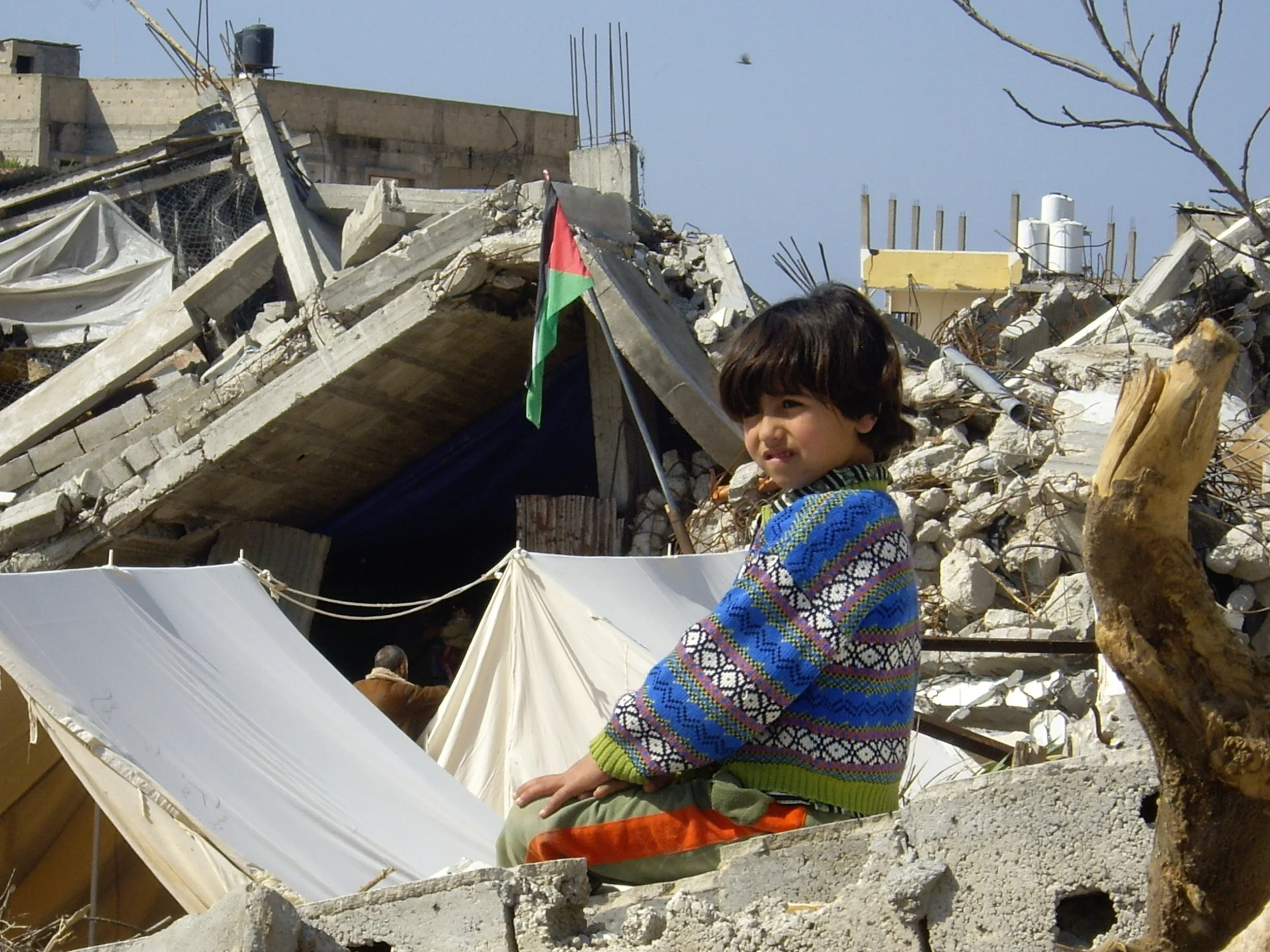
For some children, starvation, war, and constant fear are daily occurrences, and the rulers of this world are fine with that.
What does it mean to be in solidarity with children?
The point of the essay for Lane-McKinley isn’t so much to spell out the problems and the solutions, as she sees it, but rather to consider how “we imagine a political movement that’s not 'for the children’ but actually with children and for our future?
Childhood, mothering & the family
My own childhood of the ‘80s and ‘90s was riddled with physical violence: spankings, belt-whipping, and slaps to the head so hard that it literally wobbled. Under the crushing weight of poverty, securing housing, food, and transport, which so many working-class families struggle with, my parents did the best they could, using the same methods to raise my sister and me as they learned from their parents. With no money for a regular childminder, and both parents working full-time, my sister and I were sometimes left unattended at home as young as five and six. Today, parental violence against children is outlawed in Ireland and frowned upon - even though some pine for its return - and Tusla advises that children aren’t to be left unattended until they’re 13.
“Childhood operates as a series of stories that we are told, beginning in early life, and that we learn to tell ourselves and each other,” Lane-McKinley writes. From even before a child is born, with questions about the baby’s sex, to how you answer the questions children ask about how and why things are. “Why do we say free Palestine?” “Why did the police sometimes not be good to protestors?”
How are we to navigate the time when children are children, learning and developing, not yet adults, but also with equal desire for freedom and autonomy? How do we keep them safe from an increasingly complex and dangerous world without reverting to adult authority? Solidarity with Children doesn’t offer any easy answers. Rather, it’s like my three-year-old asking about everything we take for granted when it comes to kids and forcing us to reckon with the inadequate and sometimes harmful ways we answer.
Why do we cook, clean, and labour for children? Is it a “labour of love” that is unwaged, productive for capital or not? And, is it actually helpful to focus merely on the work of caring for children, the hours spent cooking and cleaning or the hours of lost sleep, breastfeeding, or changing nappies?
The wages for housework campaign initiated in the 1970s helped to illuminate the invisibilised care work by housewives, galvanising women across the world to fight back against the expectation that they alone were responsible for care work. Yet, Lane-Mckinley points out that “children do not exist at the margins of this political project; rather, they are its absent center”. The wages for housework campaign pitted not only wife against husband but also mother against children. They require work from me.
For many housewives, the responsibilities of rearing children and managing a household shackled them to a stunted and isolated life. Housework, including rearing your children, wasn’t just coerced; it was a barrier to their full development.
Rather than viewing motherhood as something to reduce or even get away from, Lane-McKinley invites us to consider bell hooks’s conceptualisation of motherhood as a “humanizing labor.” She writes,
“It is not labor disguised as something else, unwaged yet implicitly compensatory, naturalizing and therein enforcing work that is isolative but also actively de-collectivizing. It is a laboring that, if only in brief glimpses, and however indirectly, gets at the possibilities of what could be otherwise.”
Caring for your child today is determined by the society in which we live, a capitalist society. Everything has to be managed in some way or another by one or both of the parents. Meals, clothes, play, bedtime, on repeat. That is to say, care work is often burdensome not because it’s work per se, but because it’s incessant. It’s individualised within nuclear families, between one or two parents who struggle to provide all the care necessary for children from birth to adulthood. This is why the demand for “wages for housework” limits our liberatory horizon. We want the work recognised and valued. But ultimately, we want the socialisation of housework and child-rearing alongside the abolishment of the family and its version of motherhood. We seek to create communities of families mothering all children, collectively.
Lane-McKinley argues that there “is no biological constraint” to who can mother...There is an ideological barrier, which can absolutely be overcome.” Doing this would require relinquishing at least some of the control we have currently over our own children. Socialists or not, under capitalism, every parent is a dictator in their child’s life. Legally, they are entitled to make almost every decision on their behalf, often with damaging consequences. Extreme examples include the refusal of certain kinds of healthcare to children on religious or political grounds, like blood transfusions or puberty blockers. But there are many more mundane examples where parents dominate their children's lives on a “normal” day-to-day basis, telling them when to go to bed and when to get up, what to eat and what not to eat, where they are going and what they are doing today and so on.
““Socialists or not, under capitalism, every parent is a dictator in their child’s life.””
Lane-McKinley theorises the broader significance of these parent-child power dynamics when she writes that
“Adult power represents the final vestige of unquestioned “natural” order in this world, hence its vital role in justifying and maintaining all other forms of domination, through the infantilization of the disempowered…So long as there are “adults,” there will be “children”: in this sense, child liberation and the abolition of adulthood go hand in hand.”
She is unclear here on the question of what in childhood or adulthood is worth preserving and what should be dispensed with. At times, she is critical of the whole concept of childhood; at other times, she complains that it only applies to some children and not to others, leaving it unclear as to whether her solution is to universalise childhood or abolish it.
While it is true that childhood is a relatively recent bourgeois invention whose practical applicability is often limited to better-off white children living in the imperial core, aspects of it are socially progressive - such as the outlawing of child labour and the obligation on parents to have their children educated. That both of these are under attack by the far right, with attempts to overturn bans on child labour in some US states and massive increases in homeschooling since the Covid pandemic, demonstrates the point.
For Marxists, “abolition” is never a straightforward destruction but rather a creative destruction and novel recombination of pre-existing social elements on a higher plane of development. So elements of the current institutions of childhood, adulthood and the family would be retained in an ecosocialist society. Care, protection, love and reproductive labour would still exist but would be organised freely and collectively, rather than being privatised, constrained and monetised in authoritarian nuclear families and neoliberal markets.
The book also doesn’t have a lot to say about the perhaps unavoidable reality that some sort of benign authority is needed in the care of infants and very young children - so they don’t injure themselves and so they can learn about the world. I might not want to predetermine what my children think, but I do still need to answer their constant stream of questions!
In a Revolutionary Left Radio podcast, Lane-McKinley shares some interesting thoughts about how to involve children in decision-making from a young age and about how honest, or not, to be with them about the world. Her personal decision about Santa Claus (!) may not resonate with too many parents, but it raises important questions about what the implications of having radical politics might be on how socialists parent - both in the here and now under capitalism and in a future socialist society.
Building the commune
In the final chapter, Lane-McKinley offers some ideas about how we might reimagine the world we’re trying to create in solidarity with children. The Black Panthers’ Free Breakfast for School Children is a beautiful example of community care that gives a glimpse of the kind of future we’re aiming for. One where children’s needs are provided collectively. And not just food. The Panthers also taught the children about Black History. As one Panther, Miriam Ma’at-Ka-Re Monges explained to Lane McKinley, the “pedagogical aspect of the project…was the most important part.”
The Oaxaca Commune is another example. It emerged from an extended teacher’s strike after the state responded with violent repression. At the barricades, the teachers, many of whom were also mothers, found new ways to radically reorganise care work to ensure their children were taught, fed, and generally cared for. In moments of ongoing protest, strikes and revolutionary struggle, when adults are compelled to combine family, political and social responsibilities, new forms of collective care can arise.
Another example is the assistance Irish families provided to the nearly year-long miners' strike in Britain in 1984. Money was raised by local support groups like The Tallaght Committee to Support Mine Workers to bring miners' children to Ireland for a holiday.
““In moments of ongoing protest, strikes and revolutionary struggle, when adults are compelled to combine family, political and social responsibilities, new forms of collective care can arise.” ”
We don’t need the pressure of revolution to reimagine care work. In small but important ways, political and community spaces are either open to and safe for children or not. Which means, they are spaces for parents of young children, particularly mothers, or not. Lane-McKinley describes her experience attending a political summer camp that advertised childcare but ended up being “too ad hoc”. Still, her family enjoyed it enough to come back, and each year she and other families and caretakers worked together to improve the kids’ part of the camp. They also developed a programme that allowed the children some autonomy, so they could decide what they were doing at the camp rather than having it dictated to them.
If we’re serious about building the commune, a space where all our needs are met through community, Lane-McKinley’s essay is a provocation to consider who is included in “our”. “Every day of sharing a life with children, it’s hard to avoid confusion, frustration, anxiety, fear”, she writes. “In the absence of solidarity, wishing away these feelings may seem easier than trying to work through them.” In some ways, it’s easier to imagine an ecosocialist world where our relationship with children, moulded by capitalist society, endures. There are so many facets of society that need reimagining; we can sometimes forget the children. Solidarity with Children is ultimately asking us to reimagine the future by focusing on “experimenting” with the present arrangements and relations between adults and children. “What we discover in these experiments can never be a complete vision; yet the more we learn to question the logic of adult supremacy in our everyday lives, and to devise other ways of caring for children, the closer we get to the possibility of solidarity.”