Save the Boyne
By Aidan Ring
How a proposal by a meat company to build a pipeline to discharge effluent into the Boyne raised a local community army to stop them
I will never forget the feeling when I opened that letter from Meath County Council in April 2022. It seemed unthinkable that they would say yes to a proposal by a meat factory to discharge 400,000 litres of effluent per day into the River Boyne. It was galling to even have to say that, for many reasons, this was a bad idea (a familiar feeling to activists the world over). Fundamentally, it risked polluting the drinking water of around 70,000 people and disrupting a designated Natura 2000 site in one of Ireland’s most biodiverse ecosystems. The pipeline would threaten angling, kayaking and hiking groups, all significant economic and social drivers in the area. Furthermore, the company itself, Dawn Meats, had previously been fined for 25 separate breaches of environmental regulations1.
On a deeper level, the Boyne Valley has been a treasure trove of artefacts2, and it encompasses some of our most ancient sites such as Newgrange, Knowth and Dowth. It is one of the last strongholds of the salmon, a cultural and ecological symbol. No wonder the name Boyne is derived from Boann, the River Goddess – saying yes to this pipeline would be an insult to the memory of our ancestors… right?
And yet, yes is exactly what Meath County Council said.
Despite the over 450 objections (including my own and one from Louth County Council) and the fact that there were several Meath councillors against it, including Councillors Peter Whelan and Elaine McGinty, Meath County Council betrayed their county development plan (including a greenway along the same section of river!). Even though I did not live in the area, when I opened that letter and saw a big, red ‘Approved’, I cried.
These were tears of helplessness and frustration. This was the response when it hit home that the Council, which is supposed to protect the interests of ordinary people, was instead choosing to protect the interests of a meat company with a dismal environmental track record.
But one thing I didn’t feel was surprise. Indeed, lack of institutional accountability and transparency, and the resulting erosion of public trust, were topics which I had been researching for my Master's thesis in Environmental Psychology at RUG in the Netherlands. The research brought me to the campaign with a unique line of enquiry. As a long-time activist, I wanted to explore what motivates people to protect nature against threats. I read everything I could find about citizens’ responses to environmental threats around the world (a sad but fascinating adventure), and then I contacted the Save the Boyne Facebook page to feel it out as a case study. Subconsciously, perhaps, my thesis was an attempt to understand myself better as an activist and to be more effective. But, inevitably, I got swept right up in the campaign and the great people involved.
It turns out I wasn’t so helpless after all.
Building the campaign
Before beginning the research, I needed to dive into the Boyne’s waters (literally and figuratively) and to speak with the campaign team. So I drove out on a gorgeous late summer’s day to a bend in the River Boyne near Yellow Furze, and, immediately, I could feel the vibrant beauty of the place. There I met Tommy McLarnon.
Tommy started the campaign through a Facebook page in 2021, which has since amassed ten thousand members. A website was later established, savetheboyne.org. In the early days, the campaign was mostly focused on awareness-raising, empowering and informing local citizens to assess and object through online templates.
However, once Meath County Council said yes to Dawn’s application, we stepped things up a notch, now focusing our energy on appealing to An Bord Pleanála (ABP), who would make the final decision. We held public strategy meetings, organised by Cllr Peter Whelan. In that room, there were politicians, farmers, water sports instructors, anglers, activists, legal experts and regular citizens. I believe this diversity was key to the campaign’s successes. As Tommy said,
“People had different connections with the water, they could be ancestral, spiritual, sporting connections… The issue crossed all political divides. I think people realised that we have to speak for Nature and for Life. If the only time a river has a voice is when it becomes polluted, then it’s too late!”
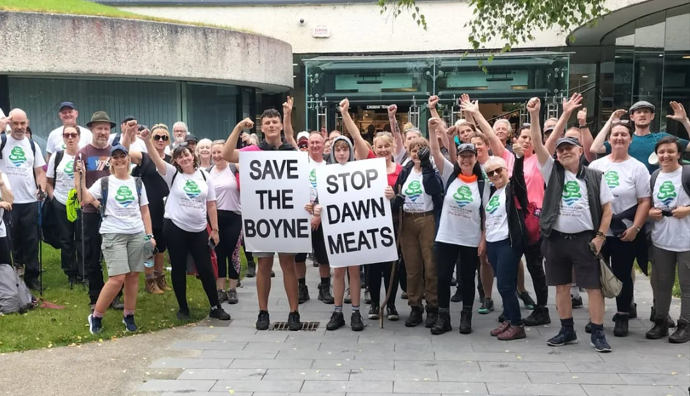
A GoFundMe was organised by Tommy to pay for the website, objections to ABP (which are not cheap), environmental reports and, of course, Save the Boyne signs and placards. To generate media coverage, I spoke about the issue on the local radio station, LMFM, and we got several articles into the Meath Chronicle. A big boost came when Pierce Brosnan, a former James Bond actor, released a video3 in support of the campaign. Throughout the months, we did a Boyne clean-up day and three walks along the Boyne from Newgrange to Slane, about a 6km hike. The unparalleled Mog Downey, the Sustainable Development Goals Advocate Coordinator of the Development Perspectives NGO, did a lot of the organisational heavy lifting, with press releases and media coverage keeping the issue current.
There was a growing acceptance that this issue might take us to the European Courts of Justice – we were in it for the long haul if necessary. There was also a subgroup, a ‘radical flank’, more than willing to take direct action if necessary. As of now, it has not come to this, but it indicates the level of opposition and anger, and willingness to personally sacrifice to protect the River Boyne.
One of the best things to combat the stress of a threat to your local environment is to take action, any action – I could feel this myself at the public meetings. While there was sadness and frustration, there was also hope - it feels good to do something. This is also why community is so important; people will often only take action if they feel their action will make a difference. When people come together to collectively fight back, they are empowered.
Success?
Naturally, there was no engagement with citizens from either Dawn Meats or Meath County Council – all were unresponsive when we reached out. However, on 21 January 2025, nearly three years after Meath County Council granted approval, An Bord Pleanála gave its verdict.
They said no to the pipeline. Why?
“… insufficient information has been submitted… to adequately demonstrate that the… development would not adversely affect water quality in the River Boyne, which is linked with human health, biodiversity and natural and agricultural resources (tourism etc).”
We breathed a temporary sigh of relief. Then, in mid 2025, Dawn Meats submitted another proposal, this time to discharge their effluent underground. Of course, people objected to this, too. Perhaps realising their mistake, however, Meath County Council refused it on quite extraordinary grounds – Dawn Meats, in a wanton display of contempt, appeared to have been making up figures, as if they thought this would not be noticed.
Meath County Council noted that “…identical results under numerous headings on subsoil characterisation and… results for testing at 11 percolation test holes across the site in 2023 record identical percolation test results, which raises questions on the credibility of the submitted information. There are no photographs.”
How we won… for now
The huge public opposition translated into a strong response in the civic arena. As it was primarily because of drinking water that An Bord Pleanála refused permission, we can imagine that 10 active appellants, all of whom focused on drinking water, did no harm in swaying ABP (who would have been well aware of the public opposition). This was bolstered by the mixture of advocates and unlikely partnerships, as demonstrated by the diversity at citizens’ meetings, as well as Pierce Brosnan’s support late in the game. You never know what unlikely partnerships will make a key difference! On this note, it was crucial to have various experts in the mix. A brilliant response from Sonairte4 (The National Ecology Centre), was submitted to MCC, which framed everything within the necessary legalese i.e. EU Water Frameworks Directive, etc. This formed the basis of the ABP appeals later. A Boyne Vision Report, delivered by Development Perspectives in early 2024 after a public consultation process, was also a great reference to have.
““While there was sadness and frustration, there was also hope - it feels good to do something.””
This diversity, in turn, helped to keep this issue hot in the media and to remind Dawn Meats and An Bord Pleanála that we were not going away. The clean-ups and walks through the elysian Boyne Valley were a great way to do this, but also to connect with each other and with the land - I had some fascinating, hilarious conversations along the tranquil banks of the Boyne. Staying so engaged is necessary when it takes ABP three years to come to a decision.
Wider Context
Companies like Dawn Meats are only allowed to treat our waterways like sewers because of Ireland’s egregious lack of proper protection for nature. There is a glaring lack of enforcement of environmental regulations. Even when they are enforced, they are paltry, barely a deterrent at all.
Thus, it feels like our environment always needs “saving”. Save the Boyne, Save the Sperrins, Save Magheramore, Save Lough Neagh… the list of such campaigns goes on. The approximately 42,000 fish killed in the Blackwater last August was the largest fish kill in the nation’s history.5 Though it occurred at the same time as North Cork Creameries discharged 51 times their permitted level of ammonia into the river, no cause was officially identified by the EPA! So many of our biggest food and beverage exporters market themselves abroad with images of Ireland’s bountiful, green land while proceeding to pillage and pollute that same land. It’s maddening.
Lest we despair or burn out, we have to remember to stick with human-sized problems – it is no use thinking you can save the world as an individual, but it is crucial to do what you can in your own world collectively with other people. On this front, there is hope in Ireland’s strong legacy of grassroots environmental protection campaigns (in stark contrast to successive governments’ appalling records of environmental protection).
The place of art & story
Art is also a great outlet for our pain. As I am a fire performer and storyteller, I felt compelled to learn the tragic story of Boann, the river goddess, and now I tell it regularly. Indeed, art and storytelling have a powerful role in motivating activism.
One piece of art (e.g., the song Fortunate Son, the documentary Planet Earth, Picasso’s Guernica) can fuel a movement. Furthermore, a major theme of Development Perspective’s Boyne Vision Report was the role of stories in the river’s protection, be they personal anecdotes, myths or legends. There is actually an Imbas section on savetheboyne.org dedicated to people’s creative expression of their love for the Boyne, an outlet just as necessary to the campaign as any academic or legal document.
“The Save the Boyne campaign was and is rooted in community, history, heritage, biodiversity, and human wellbeing…. The Boyne is far more than a resource—it is a lifeline that sustains healthy land, healthy water, and healthy people.”
Mog Downey from Development Perspectives
Victory?
We won, for now.
I would not say the future for our water looks bright though – Tara Mines have just submitted an application to increase their permitted discharge into the Boyne, another potential fight. Ireland’s nitrates derogation has been extended for another three years, the same nitrates known to cause algal blooms. Coillte’s clear-felling of monocultures is still seen as an optimal forestry model at government level.
““With our €4K from a GoFundMe, we defeated a multinational worth billions.””
All of this makes it even more important to take the wins when you get them and continue to build. And it does make me chuckle that, with our €4K from a GoFundMe, we defeated a multinational worth billions. Symbolised by that initial approval letter from Meath County Council (which lived on my bedroom wall for a time), this victory is a reminder.
It is a reminder that, when we fight collectively with equal parts love and rage, we are far from helpless.
Aidan Ring is an artist, activist, researcher, writer, photographer, retreat facilitator and Gaelgeoir based in Dublin. He has a Masters in Environmental Psychology from RUG in the Netherlands, and his current academic and artistic directions are informed by nature, identity and the place of art and story in navigating through this great turning.
Notes
1. Dawn Meats fined €75,000 following EPA prosecution. Agriland, 17 May 2023.
2. The Future of Our Pasts: Engaging cultural heritage in climate action. ICOMOS, 1 July 2019.
3. Pierce Brosnan joins Save The Boyne campaign (video), Irish Mirror YouTube channel, 22 September, 2022
4. Save the Boyne (Dawn Meats Campaign), irishriverproject.com, 18 March 2022
5. An Ecological Catastrophe on the Blackwater — and a System That Let It Happen, Swan Ireland, 10 September 2025.